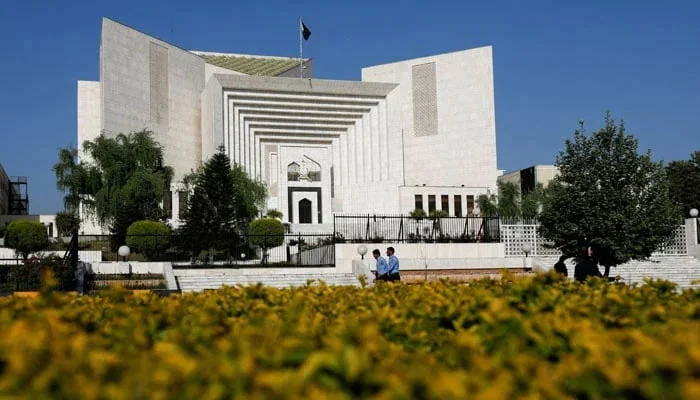
ISLAMABAD: The Pakistan Tehreek-e-Insaf (PTI) on Wednesday filed a petition in the Supreme Court challenging the 2017 amendments to the Elections Act – to “circumvent” the July 12 Supreme Court ruling on the reserved seats issue – which were passed by both the National Assembly and Senate on Tuesday.
A plea filed under Article 184(3) of the Constitution by PTI Chairman Gohar Khan through lawyer Barrister Salman Akram Raj urges the apex court to declare the Elections (Second Amendment) Act, 2024 “invalid”.
The legislation, tabled by Pakistan Muslim League-Nawaz (PML-N) lawmaker Bilal Azhar Kiyani last month, cleared both the NA and the Senate amid stiff opposition from opposition benches.
Last month, the SC declared PTI eligible for reserved seats, after which the Election Commission of Pakistan notified as many as 93 legislators from three provincial legislatures as PTI members.
Meanwhile, the ECP has also declared 39 legislators in NA as PTI members who have proved their PTI affiliation in their nomination papers.
PTI MNA Ali Muhammad Khan, speaking on the floor of the NA on Tuesday, said the government was proposing amendments to the Election Act to “attack” the SC.
The lawmaker told PTI that the party would challenge the bill in the high court. The statement was echoed by Gohar, who emphasized that despite the supremacy of Parliament, only the Supreme Court has the power to interpret the law and the Constitution.
Meanwhile, PTI’s Shibli Faraz voiced opposition to the legislation in the Senate, saying the bill was brought in “bad faith” to prevent implementation of the verdict given by the majority of the Supreme Court judges.
Defending the legislation and presenting the government’s position, Federal Law Minister Azam Nazeer Tarar said the bill was drafted before the Supreme Court’s verdict and was aimed at further interpretation.
Stressing that amending laws is a parliamentary right that cannot be claimed by any other institution, the law minister said there is a clear difference between interpreting and rewriting the constitution.
What are the proposed changes?
The law, which has retroactive effect and will apply from the entry into force of the Act on Elections 2017, proposes an amendment to Section 66 of the aforementioned legislation.
It says that if a candidate fails to submit a declaration of political party affiliation to the Returning Officer (RO) before applying for the allocation of an election symbol, he is deemed to be “an independent candidate and not a candidate of any political party”. .
The amendment to § 104 states that if a political party does not present a candidate for reserved seats within the specified period, it will not be entitled to the reserved seats even at a later stage.
In addition, a new provision § 104A is added to the original legislation, which declares the consent or sworn statement of an independent candidate to join a political party to be “irrevocable” and prohibits its revocation and substitution.

PTI moves top court against bill ‘curbing’ allotment of reserved seats